Showing posts with label Kevin Warwick. Show all posts

Tuesday, October 07, 2014

The Imitation Game film will open BFI London Film Festival 2014 tomorrow: 8 October


The Imitation GameAlan Turing biopic based on Andrew Hodges book 'Alan Turing: the Enigma' will open BFI's 2014 London Film Festival tomorrow, 8 October 2014. Simultaneous screenings of the premiere will be shown around the UK, here's my ticket :)


Alan Turing has been played previously by Derek Jacobi in 'Breaking the Code' (1996), and by Ed Stoppard in 'Codebreaker' (2011).  

This time around it is Benedict Cumberbatch who plays the tragic genius in the film that marks the 60th anniversary year of the untimely death of the tragic genius in 1954.


From my guest editorial, in a special 'Turing on Emotions' volume of major papers in The International Journal of Synthetic Emotions (IJSE):


"Alan Turing is one of those towering pioneers under whose striding shadow researchers in  many fields amble. He accomplished and  contributed more in his 41 years than many  of us could hope to in twice that lifetime." 

From here:
http://www.igi-global.com/journal/international-journal-synthetic-emotions-ijse/1144


My paper in Volume 5, issue 1 of IJSE:


"This paper makes no apology for its reading like a collection of book reports. It draws mainly on the reminiscences of Sara and John Turing, Alan Turing's mother and elder brother respectively, as well as from Andrew Hodges' extensive research on the man, his work and his impact gathered for the definitive Alan Turing biography. Alan Turing was a complex, talented man bereft of one stable and loyal companion throughout his life. He was the boy who explained Einstein's Theory of Relativity aged 15½ for his mother and the tormented outcast who gave us the modern world (Sunday Times, 2011)."

Read more here : http://www.igi-global.com/article/the-emotions-of-alan-turing/113417

Update 8 October:

Trailer for 'The Imitation Game' movie:


Coventry University continues Turing's pioneering work in machine intelligence, press notice here:

Deputy Vice Chancellor-Research, Professor Kevin Warwick said: "The Turing Test is one of the most important yet controversial milestones in the field of artificial intelligence, and Coventry University is critically involved with its practical assessment. This will have a dramatic impact on future communication not only where computers are involved but in all aspects of cyber-crime where identity and deception are key elements".

http://www.coventry.ac.uk/primary-news/coventry-university-researchers-build-on-the-pioneering-work-of-alan-turing/?theme=main

Thursday, October 31, 2013

When Two Cyborgs Met

Neil Harbisson, and pioneer of implants, Professor Kevin Warwick met at the 2045: A Futurist's Symposium in the UK in October 2013:

Neil Harbisson and Kevin Warwick*


Hear Neil's TED Talk I listen to colour: 
http://www.ted.com/talks/neil_harbisson_i_listen_to_color.html


Read about Professor Warwick at the 2009 World Science Festival: on 'Battlestar Galactica: Cyborgs on the Horizon':

"....the story of how he became the “World’s First Cyborg” yet left a deep impression. (A microchip embedded in a nerve in his wrist transmitted perceptible pulses to directly to his brain, based on signals sent via the Internet across the Atlantic ocean.)"

More here:

http://blog.ted.com/2009/06/15/world_science_f_1/


*Photo courtesy of Mariana Viada / Cyborg Foundation

Friday, August 31, 2012

Newsnight's Drone_Robot-copter and Privacy Issues

Thursday 30 August 2012 episode of BBC2's Newsnight had Gavin Esler attempting to discuss serious concerns over drone-hovering and information-capture, all without the consent of anyone caught by an offending drone's cameras, with robotics Professor Noel Sharkey and cyberneticist Professor Kevin Warwick.

Gavin Esler interviews Professors Noel Sharkey and Kevin Warwick*
 * picture from The Bureau of Investigative Journalism

Watch a clip of the discussion on BBC's News Technology site here.

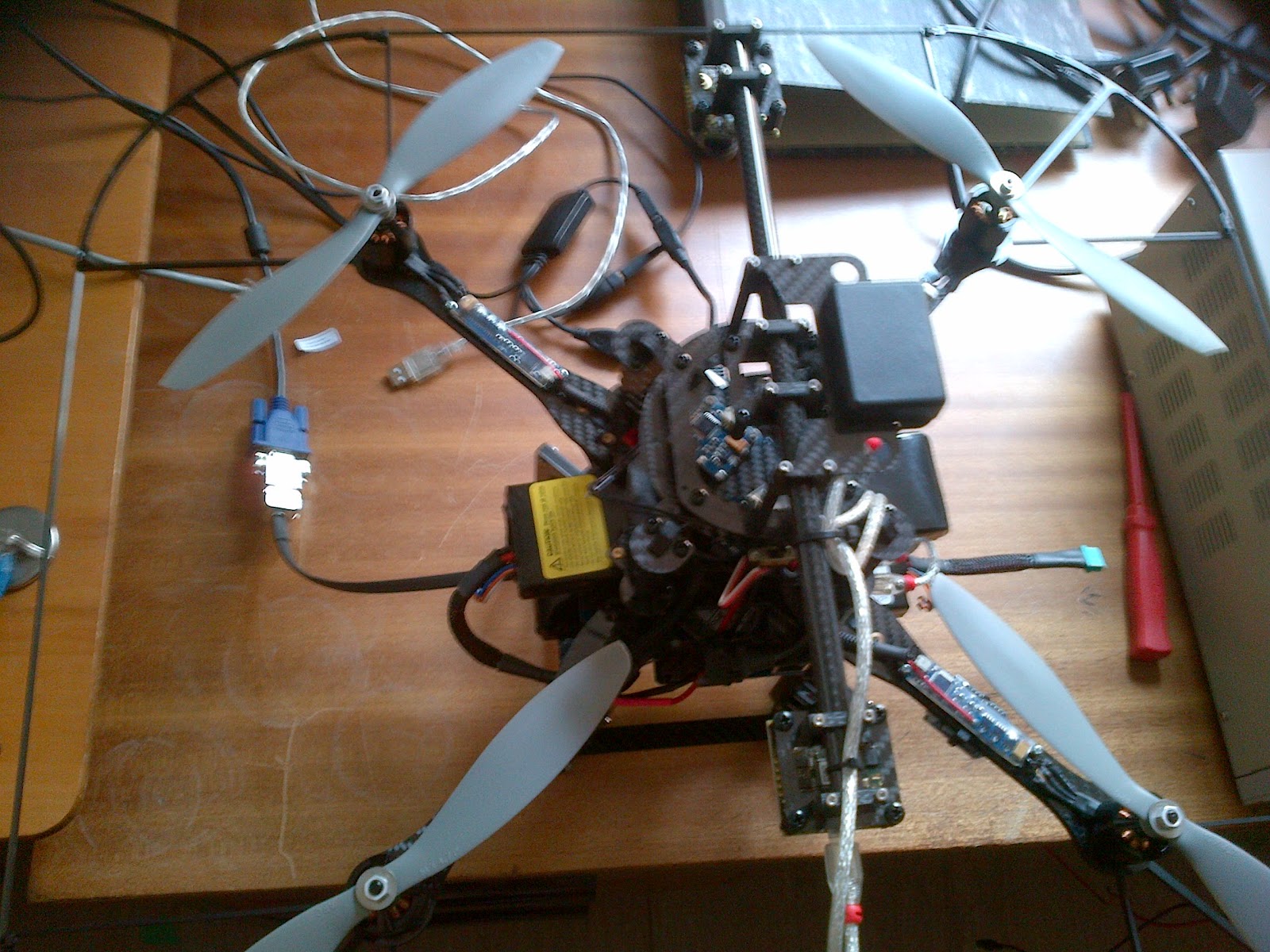
Drone Robot: School of Systems Engineering, UoReading


Articles about the Newsnight programme include:

The Bureau of Investigative Journalism's "More drone than debate: Newsnight loses track of issues at handhere.

Monday, January 11, 2010

Turing100in2012 Goes Live!

Professor Kevin Warwick's Turing100in2012 page has gone live and can now be found here.


Gradually, more information will be added about this exciting event, celebrating the brilliant 20th century mathematician in his centenary year, at a very special venue connected to Alan Turing.


Saturday, May 09, 2009

Inspiring Young Scientists

University of Reading's Professor Kevin Warwick inspires young scientists:

"University of Reading's Professor Kevin Warwick .... cited as being the inspiration of the National Young Scientist of the Year, Peter Hatfield"


From here.

Tuesday, May 05, 2009

Publications to date

Book Chapters

Emotion in the Turing Test: A Downward Trend for Machines in Recent Loebner Prizes. In (Eds, VallverdĂș. & D. Casacuberta): Handbook of Research on Synthetic Emotions and Sociable Robotics: New Applications in Affective Computing and Artificial Intelligence. Publisher: Information Science Reference, USA, ISBN: 978-1-60566-354-8, May 2009 (With K. Warwick)

Constraining Random Dialogue in a Modern Eliza in (Ed) SCHMIDT C.T.A. (forthcoming) Essays on Computers and Philosophy: From Man Through to Artefacts to Man AAAI / MIT (With K. Warwick)

Journal Papers

Testing Turing’s five-minutes, parallel-paired imitation game. Submitted to Kybernetes journal February 2009 (With K. Warwick)

ALICE.: an ACE in Digitaland. TRIPLEC: Cognition, Communication and Co-operation - Selected Papers from the 2005 European Computing and Philosophy Conference. Vol. 4 No. 2, pp 284-292, 2006

Conference Presentations

Is Understanding over-rated? Accepted for presentation at the 2009 European Conference for Computing and Philosophy (ECAP 2009), UAB Barcelona, July 2-4, 2009 (With K. Warwick)

Can a Machine Tell a Joke? presented at the 2008 European Computing and Philosophy conference, Montpellier, France, June 16 -18, 2008 (With K. Warwick and R. Carpenter)

Turing Test: Mindless Game? – A reflection on the Loebner Prize presented at the 2007 European Computing and Philosophy conference, University of Twente, Enschede, The Netherlands, June 21-23, 2007 (With K. Warwick)

Chatterbox Challenge 2005: Geography of a Modern Eliza Proceedings of 3rd International Workshop on Natural Language Understanding and Cognitive Science – NLUCS 2006 in conjunction with ICEIS 2006, Paphos, Cyprus, ISBN: 972-8865-50-3 pp 133-138, May 2006

Text-based Dialogical E-Query Systems: Gimmick or Convenience? Proceedings of the 10th International Conference on Speech and Computers (SPECOM), Patras, Greece ISBN: 5-7452-0110-X, Vol. II pp 425-428, October 17-19, 2005 (With V. Pavlika)

ALICE.: an ACE in Digitaland presented at the 2005 European Computing and Philosophy Conference MĂ€lardalens, Sweden June 2 - 4, 2005

Confederate Effect in Human-Machine Textual Interaction Proceedings of 5th WSEAS Int. Conf. on Information Science, Communications and Applications (WSEAS ISCA), Cancun, Mexico, ISBN: 960-8457-22-X, pp 109-114, May 11– 14, 2005 (With O. Henry)

Thursday, August 14, 2008

Robot with 300,000 rat neurons and brain functions


"..... the disembodied neurons are communicating, sending electrical signals to one another just as they do in a living creature. We know this because the network of neurons is connected at the base of the pot to 80 electrodes, and the voltages sparked by the neurons are displayed on a computer screen.

It's these spontaneous electrical patterns that researchers at the University of Reading in the UK want to harness to control a robot. If they can do so reliably, by stimulating the neurons with signals from sensors on the robot and using the neurons' response to get the robots to respond, they hope to gain insights into how brains function. Such insights might help in the treatment of conditions like Alzheimer's, Parkinson's disease and epilepsy.

"We're trying to understand what is going on inside this brain material that could have direct implications for human health," says Kevin Warwick, Reading's head of cybernetics, who is running the project with Hammond and Ben Whalley, both neuroscientists."


Full article in New Scientist Tech.